
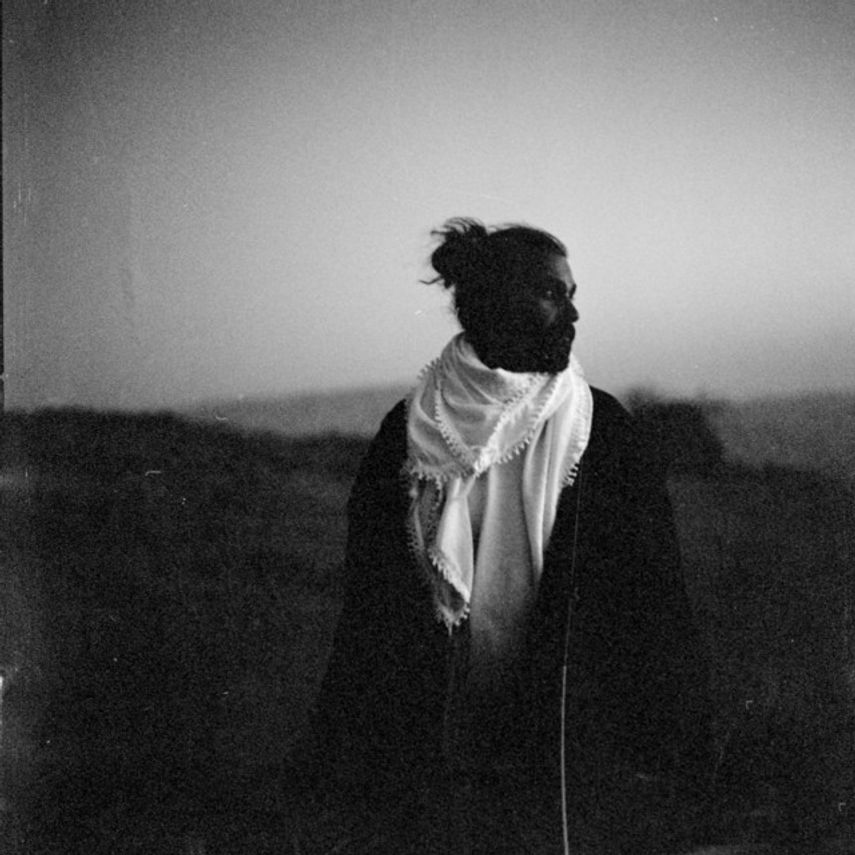
Credit: Keife Records
IRTH-TRONIC
[By: Yazan Sarayrah]
Genre: Melodic techno
Rating: 80
Cohesiveness: 85
Track quality: 74
Beginner-friendly? yes
Published 2026/08/05
Imbued with Sarayrah's Bedouin heritage, IRTH-TRONIC is at once grounded in production yet evocative and soaring in atmosphere.
But, indeed, to claim that you can (authentically) infuse Bedouin traditions into the club grooves of techno - that is, perhaps, a bold declaration.
The representation of such tradition (from various cultures) has often been a source of intrigue in electronic music. Much of the genre stems from the West, and, as such, is typically reflective of Western attitudes; of course, I have generalized, perhaps overtly so, and this discussion is far more nuanced - Japanese engineering, for instance, contributed greatly to the fundamental shaping of the scene - but to avoid such a tangent: techno, specifically, is particularly urban, having emerged from Detroit and incubated in Europe (with Germany at its heart). It is, then, a fascinating decision (at least on the surface) that Yazan Sarayrah would select melodic techno as the framework by which to explore Arabic/Bedouin culture.
Importantly, it is an exploration done without romanticisation, without oversimplification, without referential triviality. In fact, you can drop that last one entirely - IRTH-TRONIC does not flourish Sarayrah's heritage like a stylistic bell-or-whistle, but rather the entire composition is built around it. The techno, which is often so brusquely urban in nature, is instead moulded to fit like a glove around the Arabic maqam systems and Nabataean poetry - its thumping rhythms are stripped back and reinvigorated with a fashion of spaciousness that was not previously afforded to them; melodic techno can often find itself rigid, but IRTH-TRONIC is far from that.
Sarayrah's use of microtones also helps this expansiveness. It is a microtonality that maqam systems lend themselves to, allowing the melodies an extra dimension of expression. Importantly, though, this depth of expression is not caused by the microtones - much like the stoic techno kicks, they are part of the technical wrapping of IRTH-TRONIC rather than lying at its core.
In this, there is a constant sense of dynamic movement throughout the album. At times it sports the thud of a deep kick; at others its synth lines become shivering and brittle; at others still the rhythm is entirely aired out in exchange for a roomy vocal-based movement, or, like in "Theeb", for instrumentation like the electric guitar solo. Generally, Sarayrah's use of progression matches this beat for beat - for instance, the songwriting on "Ghosn Al-Gana" seems to know instinctively which paths to take, juggling the organic with the vocal with the synthesised in an adept fashion without rushing itself. This can be said for the majority of IRTH-TRONIC - the record is in no hurry, with every track (aside from the opener) breaching the five-minute mark, and a hefty proportion of those unafraid to go over a minute further.
Previously I stated that to "infuse Bedouin traditions into the club grooves of techno" was a bold declaration. There is something subtle in how Sarayrah subverts this - there is no "infusion" to be had. This is a coming-together, of electronic music being adapted into Sarayrah's own heritage. It can be perceived in the vocal presence throughout the album, one of the elements by which it anchors itself, but otherwise IRTH-TRONIC merely finds itself balanced well between organic and synthetic, maintaining good proportions of both. They bounce off each other all the way through, with the organic elements unafraid to lead the compositions, whilst the synth elements serve to widen the spectrum of movement and rhythm and pacing, a spectrum that is unique to the electronic genres. On the melodic techno side, there are tropes that surface in IRTH-TRONIC that do, at times, feel a little derivative - tropes that have notoriously plagued the genre in recent times - but some amount of it (though, admittedly, not all) must be excused to stay true to the genre conventions. If IRTH-TRONIC was to be a "coming-together" of sorts, then conventions must be acknowledged.
In entirely avoiding portraying his Bedouin heritage as exotic or gimmicky, Sarayrah takes a massive step in the right direction. It may be true that, as a technical product, IRTH-TRONIC does not have the flashiest mixdowns or the most impressive sound design. Still, the depth of songwriting, to include deeply personal cultural expression in such progressive soundscapes, must be commended.
Listen on Spotify here.
Echoes of Mo'ab
IRTH-TRONIC opens up its atmosphere quickly with the ambient "Echoes of Mo'ab", whose synth padding frames the yearning vocal nicely. The track isn't anything crazy on its own, but it does a very good job of configuring the album's mood.
Ben Hajhouj
The intricate melodic techno of "Ben Hajhouj" presents a welcome groove. Though the percussion can be a little loud, the interpolation of the vocal is well-done and grows more powerful as the track progresses.
Theeb ⭐
"Theeb" begins with a similar style of groove to "Ben Hajhouj" but quickly distinguishes itself with the introduction of the muted electric guitar. Sarayrah allows the vocal work to coalesce into an echoey pool of the sound in the opening section, before stripping everything back into clarity. From there, the track progresses nicely and cleanly, with a nifty guitar intermission, and a brilliantly shivering techno movement to finish.
Ghosn Al-Gana
w/ Ahmad Selawy
This cut presents itself as a more typical melodic techno cut - the instrumentation introduced drives it nicely, acting as an anchor by which the electronic production can wind itself around. The vocal presence is a little sparser, though, but it works well.
Ghbeshi
"Ghbeshi" immediately distinguishes itself from the previous cuts by being a little deeper and more aware of its opening melodies. The track segments itself nicely, providing space for its vocals and revving its electronic engines when it needs to continue progression.
Galo Anni ⭐
There's beauty in "Galo Anni", with its lapping techno sounds that seem to progress in a very cautious yet organic manner. The introduction of the instrumentation only helps this, and the vocal is introduced with absolute clarity in the mix. Perhaps that clarity is muddied a little by the slowly growing deep electronic sounds, but it is no matter, as the track is able to switch back into its progression easily.
Ben Jadlan
The deeper introduction works well, with the thumping techno kick immediately booting into second gear. The oscillating melody is a little derivative, but in the context of the track it works fine; the reduced vocal presence hurts the track a little, but at this late in the album a less vocal-based track works (though the vocals are certainly still present).
Ala Msiri
The longest track on the album is, aptly, this cut - the finale "Asa Msiri". It takes its time with progression (as it should), but from the start the sound design feels crisp and well-cooked. It's similar in motif to much of the previous tracks, but all the different movements are very clean.
- Theeb ⭐
- Galo Anni ⭐
- Ala Msiri
- Ghosn Al-Gana w/ Ahmad Selawy
- Ghbeshi
- Ben Hajhouj
- Echoes of Mo'ab
- Ben Jadlan